
You received your peptides, or maybe you’ve just finished reconstituting one, and now comes another question I hear all the time:
“Okay… where do I put it?”
The answer depends on a few things: whether your peptide is still lyophilized (powder) or has already been reconstituted, the specific peptide you’re working with, and how long you plan to store it.
In this guide, we’re going to break down the basics of peptide storage, what changes after reconstitution, what happens when a peptide gets warm, and why every peptide shouldn’t automatically be treated exactly the same.
Why Proper Storage Matters
Peptide stability can be affected by their environment.
Exposure to inappropriate temperatures, light, moisture, repeated temperature changes, or improper handling can contribute to degradation over time. Once degradation occurs, the same amount you used before might not achieve the same results.
One of the biggest distinctions you need to understand is whether your peptide is still in its lyophilized form or has already been reconstituted.
Before Reconstitution: Lyophilized Peptides
Most RUO peptides are supplied as a dry, lyophilized powder.
Lyophilization removes water from the product, which improves stability. This is one of the reasons lyophilized products are commonly used, for better storage and shipping.
But lyophilized does not mean indestructible.
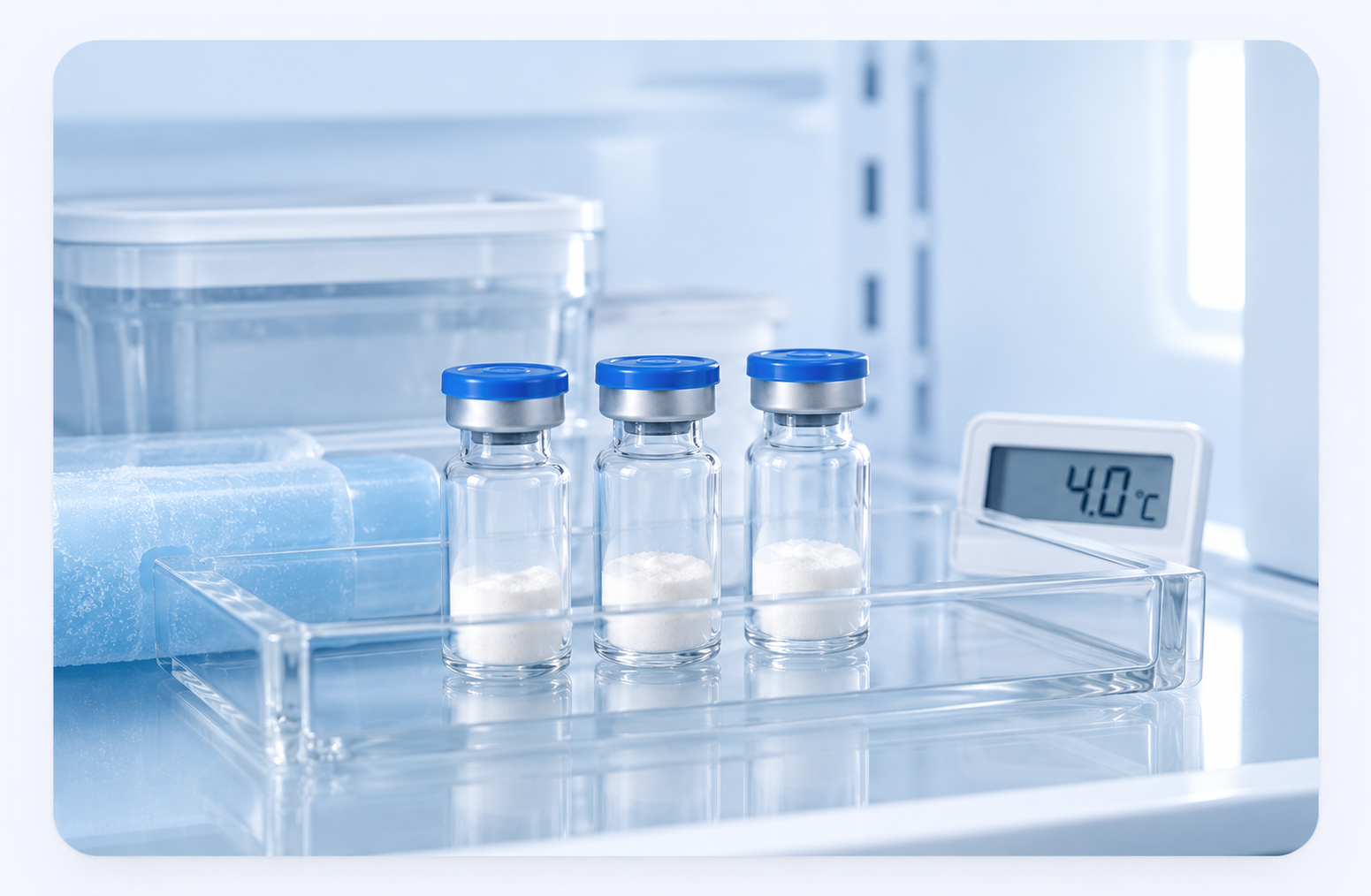
Generally, lyophilized peptides should be stored protected from light, moisture, and excessive heat. For shorter-term storage, lyophilized peptides can be kept in a cool, dark place, you can also refrigerate them to store for longer time. For extended/long-term storage, vials can be frozen.
If a lyophilized vial has been refrigerated or frozen, let the sealed vial reach room temperature before opening or reconstituting it. This helps reduce the chance of condensation introducing moisture into the vial.
Because long-term stability varies between peptides, always check the storage recommendations for the specific peptide you’re working with.
After Reconstitution
Once you add a diluent to a lyophilized peptide, you’ve changed its environment.
Reconstituted peptides require refrigeration, commonly within 2–8°C (36–46°F), but the correct temperature and stability period depend on the specific peptide
Some peptides are more stable in solution than others. Don’t assume every peptide is good for the same time. While most are stable for 30 days once reconstituted, some peptides have much shorter stability windows and may be recommended for use within as little as one week after reconstitution. SAVAMINO does a great job at providing storage and stability information for each peptide.
Temperature, Refrigeration & Light
Temperature matters—but so does where inside your refrigerator you store your peptides.
Avoid locations where temperatures changes significantly, like the refrigerator door. A more temperature stable area, like the middle section of the refrigerator, is a better option.
Personally, I store all of my peptides in a peptide storage case I purchased on Amazon and keep it in the middle section of my refrigerator. The case zips completely closed, keeps my vials organized, and helps protect them from light.
That being said, freezing a peptide after it has been reconstituted is a big NO.
What Happens if My Peptide Gets Warm?
A peptide briefly being outside its storage temperature does not mean it instantly became ineffective.
Temperature stability depends on several factors, including:
- How warm it became
- How long it remained at that temperature
A short temperature excursion and a vial sitting in excessive heat for days are not the same situation. Unfortunately, you cannot determine potency simply by looking at the vial.
Traveling With Peptides
Use an appropriate insulated container or medication travel cooler when necessary. They also sell these on Amazon for a great price.
Be careful with direct contact between the vial and frozen ice packs. Refrigerated does not mean frozen, and accidentally freezing a product can create a different stability issue.
For air travel, also check current airline and security requirements for medications, syringes, and other supplies before your trip. They are generally not an issue to pass through TSA on your carry on or personal item.
Signs a Product Should Not Be Used
Always inspect a vial before working with it. If a vial shows any of the warnings signs below, it’s best to discard it.
Warning signs:
- Cloudiness
- Visible particles
- Discoloration
- A damaged or cracked vial
- A compromised stopper or seal
- Evidence of contamination
- A solution that looks noticeably different from its expected appearance
Frequently Asked Questions
Do all peptides need to be refrigerated?
No. Storage requirements depend on whether it is lyophilized or reconstituted. Always check the product-specific requirements.
Do reconstituted peptides need to be refrigerated?
Most do, commonly at 2–8°C (36–46°F) Follow the storage instructions for the specific product.
If my reconstituted peptide got warm, is it ruined?
Not necessarily. Temperature changes need to be evaluated based on the peptide, temperature reached, and length of exposure.
Can I tell if a peptide has degraded by looking at it?
No. Visible changes can be a reason not to use a product, but not having any visible changes doesn’t prove that it is still stable.
Can I freeze my reconstituted peptide to make it last longer?
Never freeze a reconstituted peptide.
How long is a peptide good for after reconstitution?
There isn’t one answer that applies to every peptide. Stability depends on the specific peptide, formulation, diluent, storage conditions, and available stability data. We’ll cover this individually in each Peptide Guide.
KEEP LEARNING
Need to learn how to mix your peptide?
→ How to Reconstitute Peptides
Confused about mg, mL, or units?
→ Understanding Reconstitution Math
Want to know more about the most used diluent?
→ Bacteriostatic Water: What You Need to Know