
Why a 10 mg Vial Is Not “Weaker” Than a 20 mg Vial
If there’s one part of reconstituting peptides that seems to confuse people the most, it’s the math. You’ll hear mg, mcg, mL, units, concentration—and suddenly something that should be simple starts sounding way more complicated than it actually is.
The truth is, once you understand what each measurement represents, the math becomes much easier. So before we pull out our dosage calculator, let’s start with the most important concept in this entire guide.
First Things First: Units Are NOT Your Dose
This is probably one of the biggest misconceptions I see when people talk about peptides. Asking someone “How many units are you on?” doesn’t actually tell you their peptide dose unless you also know the concentration of their solution.
Because units measure the volume (amount) of liquid in an insulin syringe. They do not tell you how much peptide is contained in that liquid.
Two people could be using the exact same peptide at the exact same dose and still draw completely different numbers of units into their syringes.Two people could have the exact same peptide and take the exact same dose, but one could draw 10 units while the other draws 20 units into their because they reconstituted their vials with different amounts of bac water.
There are commonly used reconstitution volumes for certain peptides, but that doesn’t mean everyone reconstitutes their vial exactly the same way.
The easiest way to remember the difference is:
UNITS = VOLUME
A way of measuring how much liquid is in the syringe.
MG or MCG = AMOUNT OF PEPTIDE
A way of expressing how much peptide is that amount of liquid.
So when someone tells you, “I use 10 units,” you’re still missing an important piece of information: 10 units containing how much peptide?
That’s exactly what we’re going to learn how to figure out.
Understanding mg, mcg, mL & Units
mg (milligrams) = a measurement used to express an amount of peptide. Peptides are dosed in mg.
mcg (micrograms) = a smaller measurement used to express an amount of peptide.
1 mg = 1,000 mcg. Peptide dosages that are less than 1mg are dosed in micro(smaller) grams, mcg.
mL (milliliters) = a measurement of liquid volume(amount.)
Units = markings used to measure liquid volume on a U-100 insulin syringe.
100 units = 1 mL
Understanding Your Vial
A 10 mg Vial Is Not “Weaker” Than a 20 mg Vial
When you see 10 mg, 20 mg, 50 mg, or another amount printed on a peptide vial, that number tells you the total amount of peptide contained in the entire vial.
It does not tell you how many units to draw into a syringe, and a higher number does not mean the peptide is stronger.
Let’s use Retatrutide as an example.
A 10 mg vial of Retatrutide contains 10 mg total.
A 20 mg vial of retatrutide contains 20 mg total.
The 20 mg vial isn’t a “stronger” version of Retatrutide. It simply contains twice as much peptide in the vial, meaning it can last twice as long while using the same dosage.
While buying a larger vial can sometimes give you more bang for your buck, more isn’t always better. Every peptide has its own stability considerations, and some degrade more quickly than others after reconstitution. We’ll break down the specific stability of each peptide in its individual peptide guide.
Vial mg = the total amount of peptide you have—not the amount contained in each syringe draw for dosing.
Understanding Concentration
Now that you understand what’s actually inside your vial, let’s talk about concentration.
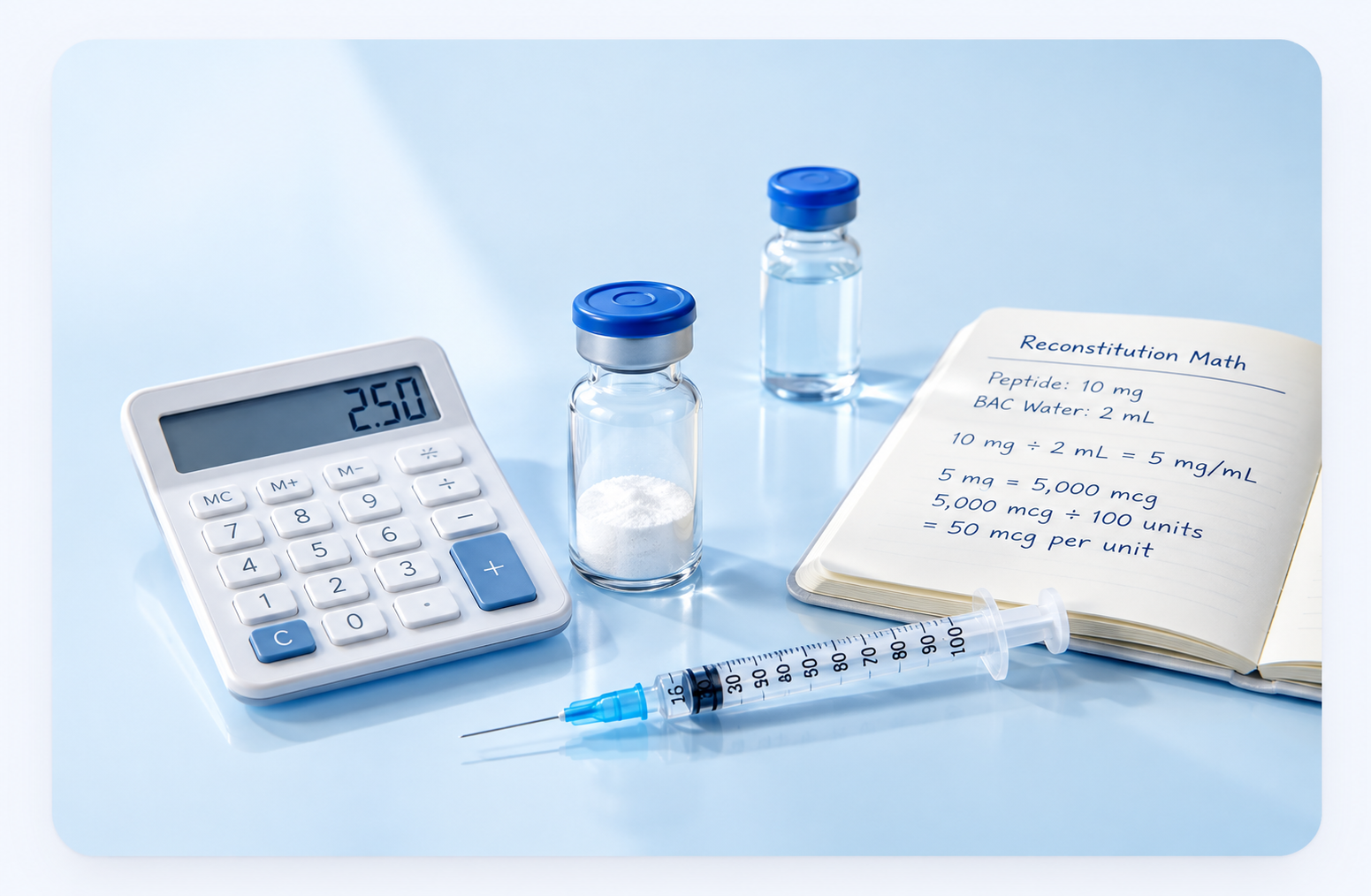
Concentration tells you how much peptide is contained within a specific volume of liquid after the peptide has been reconstituted. Without getting to technical with the numbers, a general rule is per every 10 mg you add 1 mL of Bac water, that way every 10 units = 1 mg. This is equal parts Bac to peptide.
More BAC Water = More Diluted
Less BAC Water = More Concentrated
Think about it like making a glass of lemonade.
If you have the same amount of lemonade mix but add more water, you haven’t changed how much lemonade mix you started with, you’ve just spread it throughout more liquid, making each sip less concentrated. Peptides work the same way when we’re talking about concentration.
This is also why the number of units you draw into your syringe depends on the concentration of your solution.
A more concentrated solution contains more peptide within the same volume of liquid, while a more diluted solution contains less peptide within that same volume.
So remember:
Changing the amount of BAC water does NOT change how much peptide is in your vial. It changes how much peptide is contained within each unit/mL of your reconstituted solution.
This is exactly why asking someone “How many units do you use?” doesn’t tell you their actual amount unless you also know how their vial was reconstituted.
How to Read an Insulin Syringe
Now that we know units measure liquid volume, let’s look at what those units actually mean on a U-100 insulin syringe.
A U-100 syringe is designed so that 100 units = 1 mL of liquid.
That means:
100 units = 1 mL
50 units = 0.5 mL
25 units = 0.25 mL
10 units = 0.1 mL
5 units = 0.05 mL
Pay Attention to the Lines on Your Syringe
This part is important because not every insulin syringe has the same markings.
On many 100-unit (1 mL) syringes, each small line usually represents 2 units.
On many 50-unit (0.5 mL) syringes, each small line usually represents 1 unit.
However, syringe graduations can vary by manufacturer and syringe size, so never assume what each line represents based on if it’s a 100 unit or a 50 unit syringe. Look at the numbered markings and count how many spaces are between two numbers. This will tell you how many units each small line represents. For example, if the syringe goes from 10 to 20 and there are 5 equal spaces between them, each space equals 2 units.
Putting It All Together
Don’t Want to Do the Math Every Time?
You won’t have to.
I’ve linked a Peptide calculator here to make the math easier. Simply enter the mg information from your vial and amount you want to use to reconstitute in mL, and the calculator can help you determine the concentration and corresponding syringe measurement.
In each individual Peptide Guide, I’ll also show you exactly how I reconstitute my peptides and what dosage I use.
Common Math Mistakes
- Thinking units = dose
- Confusing mg and mcg
- Forgetting 1 mg = 1,000 mcg
- Assuming everyone drawing “10 units” is getting the same amount
- Assuming a higher-mg vial means the peptide itself is more potent
- Copying someone else’s syringe units without knowing their concentration
- Forgetting that changing the amount of BAC water changes the concentration
Frequently Asked Questions
If I add more BAC water, does it make the peptide weaker?
No. Adding more BAC water does not change the total amount of peptide in the vial—it makes the solution more diluted. This means the same amount of peptide will be contained in a larger volume of liquid.
Does a 20 mg vial work better than a 10 mg vial?
No. A 20 mg vial isn’t stronger or more effective than a 10 mg vial of the same peptide. It simply contains twice as much peptide overall.
Why am I drawing 20 units when someone else only draws 10?
Most likely, your solutions have different concentrations. Remember, units measure liquid volume, not the amount of peptide. Two people can draw different numbers of units while still measuring the same amount of peptide.
Are units and mg the same thing?
No. Units measure liquid volume on a U-100 insulin syringe, while mg measure the amount of peptide or in other words the dosage. You need to know the concentration of your solution to determine how many mg or mcg are contained in a certain number of units.
How many mcg are in 1 mg?
1 mg = 1,000 mcg.
For example, 0.5 mg = 500 mcg and 0.25 mg = 250 mcg.
Does adding more BAC water give me more peptide?
No. The amount of peptide in the vial stays exactly the same. If you have a 10 mg vial, you still have 10 mg total whether you add 1 mL or 2 mL of BAC water. Adding more liquid simply changes the concentration of the solution.
KEEP LEARNING
Need to learn how to reconstitute your peptide?
→ How to Reconstitute Peptides
Wondering how to store your peptide after reconstitution?
→ Peptide Storage & Stability
Still have questions about bacteriostatic water?
→ Bacteriostatic Water: What You Need to Know