
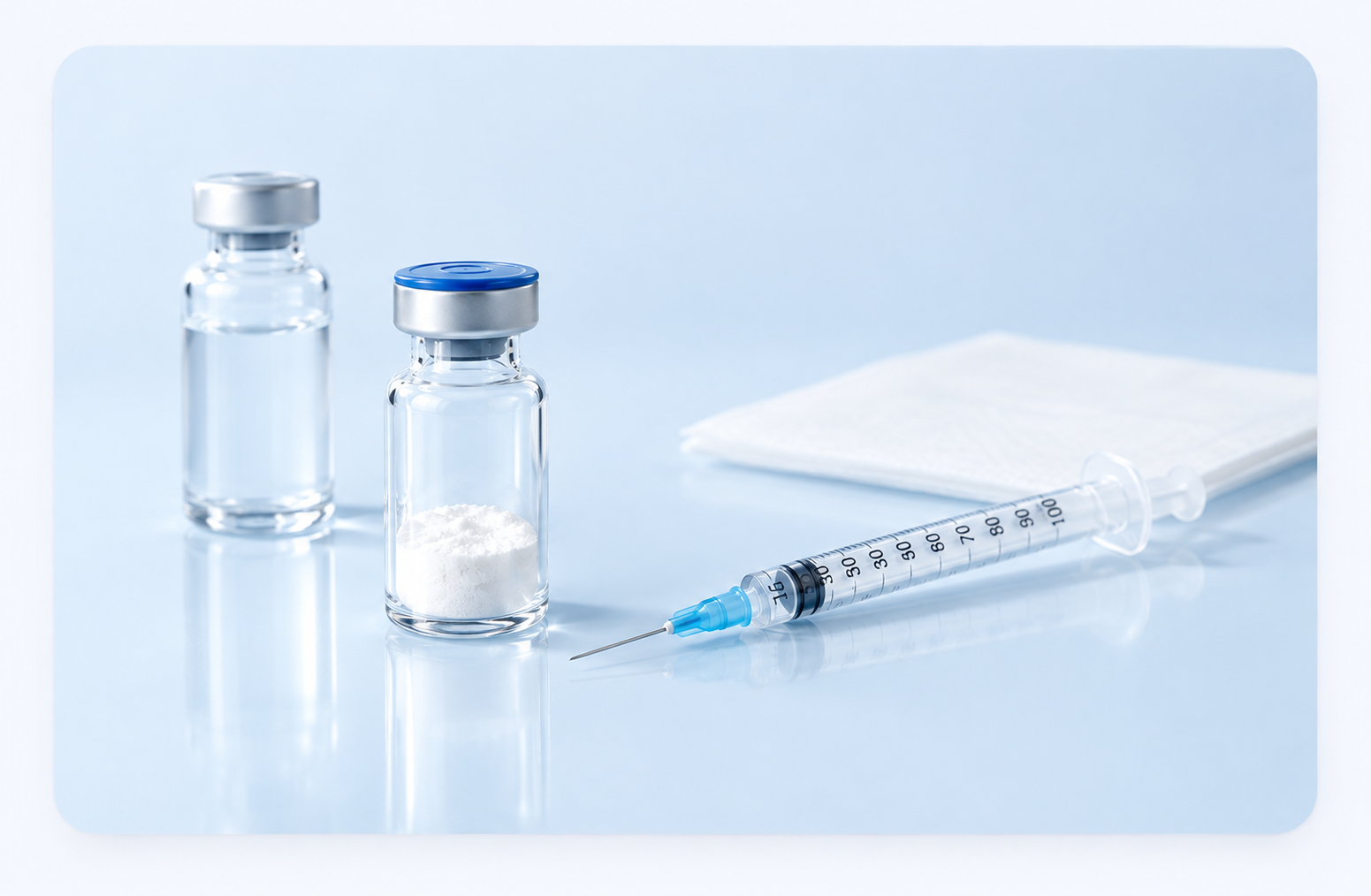
If you’ve heard of peptides, chances are you’ve also heard the word “reconstitute” and thought to yourself, okay… what exactly does that mean?
Most peptide products you receive from an RUO (Research Use Only) website come in lyophilized form, meaning the peptide is a dry powder inside the vial rather than a liquid. Before that peptide can become a liquid for your research, it needs to be reconstituted—which simply means adding an appropriate diluent to the vial to dissolve the powder.
It might sound complicated at first, but once you understand what reconstitution actually means and how the process works, it becomes much easier to follow.
In this guide, we’re focusing specifically on the reconstitution process itself: what you need, how to prepare, and the basic steps involved. We’ll save the math, storage, and everything you could possibly want to know about bacteriostatic water for their own, separate guides.
What Does Reconstitution Mean?
When you receive a lyophilized peptide, the powder you see inside the vial is the peptide after water has been removed through a freeze-drying process. Removing the water helps improve stability, making lyophilized form ideal for storage and shipping. Reconstitution is the process of adding the appropriate liquid back to that powder to create a solution for its intended use.
One important thing to understand is that reconstituting a peptide and calculating its concentration are two different things. The reconstitution process follows the same steps from one peptide to another; what can change is the type and amount of diluent required, although bacteriostatic water is the most used diluent for many peptides. The amount of diluent you add determines the final concentration of the solution, which is why it’s important to follow the instructions for the specific peptide you’re working with.
What You’ll Need
Before beginning, gather everything you need so you aren’t searching for supplies halfway through the process.
Typically, this includes:
- Your lyophilized peptide vial
- Bacteriostatic Water
- A sterile syringe suitable for transferring the diluent
- Alcohol prep pads
- A clean workspace
- A sharps container for used needles or syringes (an empty laundry detergent bottle works!)
Step-by-Step Reconstitution
- Clean the vial stoppers. Wipe the rubber stopper of both the peptide vial and the BAC water vial with alcohol and let them air-dry.
- Prepare the diluent. Using a new, sterile syringe, draw up the volume (amount) needed for the peptide you’re working with.
- Add the diluent to the peptide vial. Slowly inject the liquid so that it runs gently down the inside wall of the vial rather than directly onto the powder. Avoid spraying the diluent directly onto the powder.
- Allow the powder to dissolve. You can gently swirl the vial, gently roll it between your hands, or simply allow it to sit undisturbed for a few minutes until the powder has completely dissolved. NEVER SHAKE A RECONSTITUTED PEPTIDE VIAL.
Your peptide is now reconstituted. You can either use it right away or store it in the refrigerator at 2–8°C (36–46°F) and use at a later time.
Frequently Asked Questions
Is reconstitution the same thing as mixing?
Yes, they’re basically the same thing. You’ll often hear people refer to the process as “mixing,” although the correct term is reconstituting.
Do all peptides need to be reconstituted?
No. Some peptides may already be supplied as a liquid solution. Although we’ll get into this more in our Peptide Storage & Stability guide, pre-reconstituted peptides and peptide nasal solutions require refrigeration. If you receive a reconstituted solution and it is hot, 99% chance it will not be effective.
Can I use the same amount of diluent for every peptide?
No. The amount of diluent used can vary depending on the specific peptide and determines the final concentration of your solution. We’ll talk about this more in Understanding Reconstitution Math.
Why shouldn’t I shake the vial?
Peptides are sensitive to physical stress. Vigorous shaking can disrupt their structure and contribute to degradation, which is why gentle handling is preferred. Never shake a reconstituted peptide vial.
How do I know how many mg are in each syringe unit after reconstitution?
That’s where the math comes in. The answer depends on the amount of peptide in the vial and the total volume used to reconstitute it. We break that down separately in Understanding Reconstitution Math.
KEEP LEARNING
Confused about mg, mL, or units?
→ Understanding Reconstitution Math
Wondering how to store your vial afterward?
→ Peptide Storage & Stability
Still wondering what bacteriostatic water actually is?
→ Bacteriostatic Water: What You Need to Know